



Industrial automation solutions, seamlessly integrated
Sensing, motion, control, vision, components, safety & robotics
Automation products that work together perfectly, reducing complexity for machine builders and system integrators, to achieve flexible and efficient production — all from one source
What's new?
Discover our latest automation products
How can we help you?
Questions, quotes or technical support? Contact us now.
See all contact optionsInsights
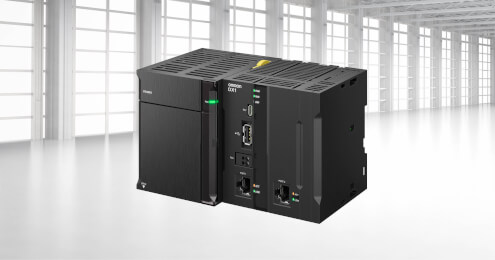
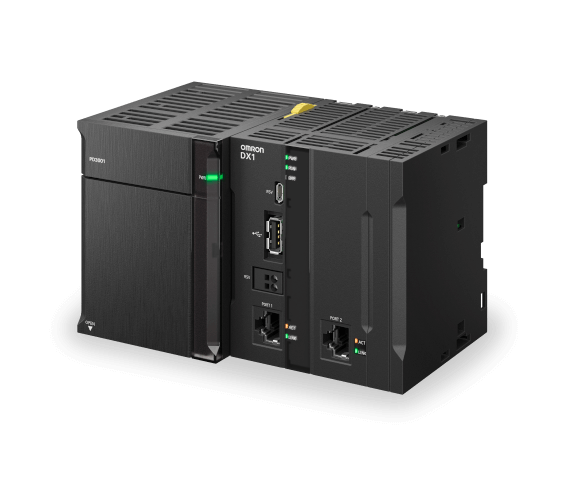
OMRON Introduces DX1 Data Flow Controller
Easy-to-use industrial edge controller for fast and reliable on-site data utilization and visualization
Learn more
Automation Technology Center Autonomous Mobile Robots Annecy, France
Join us for a virtual visit to our ATC Mobile Robotics in Annecy, France. Find out how to improve flexibility and productivity with the help of innovative autonomous and collaborative robotics.
Learn more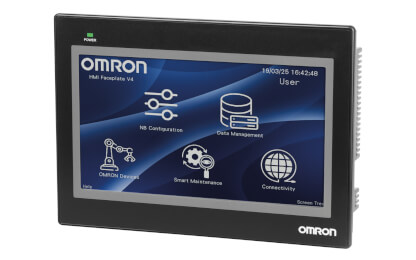
User-Friendly and Simple to Design with NB Faceplate
Our cost-free NB-Faceplate makes the integration process smoother by facilitating connections with OMRON devices and the configuration of essential HMI functions, such as communication, settings, recipe management, multilingual support, trend analysis, data logging, and security options.
Learn more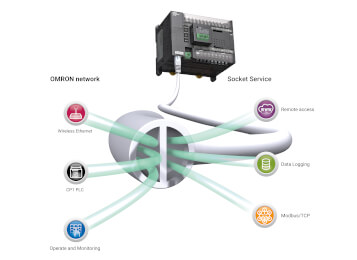
Upgrade CP1L-USB to CP1L-Ethernet or CP2E for Future-Ready Performance
Ethernet Model enhances remote and HMI connectivity
Learn more
Automation Technology Center Autonomous Mobile Robots Annecy, France
Join us for a virtual visit to our ATC Mobile Robotics in Annecy, France. Find out how to improve flexibility and productivity with the help of innovative autonomous and collaborative robotics.
Learn more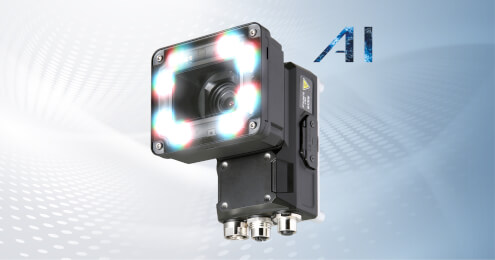
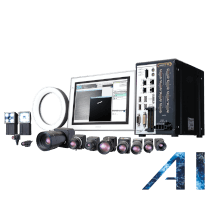
OMRON introduces FHV7-AI Detection Camera to simplify AI-based quality control
The FHV7-AI Detection Camera is the latest addition to OMRON’s proven family of industrial vision systems. The new model combines advanced AI-driven inspection capabilities with a simplified, step-by-step user interface and a compact, all-in-one design – reducing engineering time and overall cost of ownership. This allows manufacturers and machine builders to implement high-accuracy inspection without complex setup or specialized expertise, or inflated product budgets
Learn more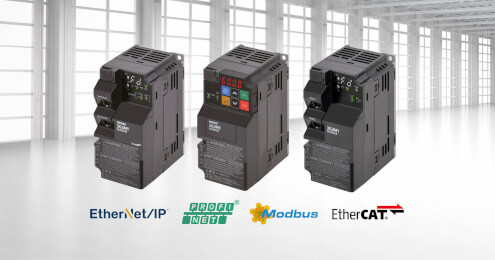
OMRON launches M1-EMP AC Drive with multiprotocol Ethernet support
OMRON has expanded its M1 Compact AC Drives family with the new M1-EMP (Ethernet Multi Protocol) model. AC drives, often referred to as inverters, are a core component of industrial automation, controlling the speed, torque, and position of electric motors in machines and production systems. They help manufacturers improve energy efficiency, achieve precise motion control, and adapt equipment to changing process demands.
Learn more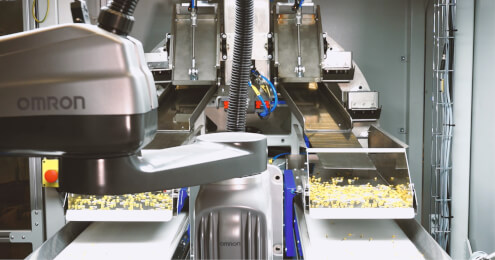
An innovative feeding solution for cable harness production
OMRON and ERKO have developed an innovative, fully automated workstation for cable harness production.
Learn more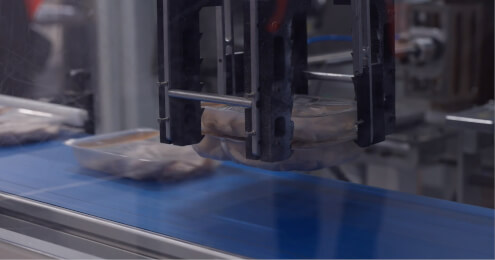
CP Foods UK automates poultry packing with OMRON & Gripple Automation
High-speed, high-quality packaging line helps meet retail demands
Learn more
Bridging the IT/OT divide: Practical steps toward a connected future
AI, data, digital twins, and IT/OT convergence dominate today’s industrial agenda. Yet for many manufacturers, one challenge remains unresolved: bridging the gap between the enterprise systems that plan the work and the operational technologies that make it happen. ERP systems and MES platforms still sit on one side of the wall, while PLCs, sensors, and robots operate on the other. For decades, Information Technology (IT) and Operational Technology (OT) have advanced in parallel rather than together. IT delivers data, analytics, and corporate visibility; OT ensures uptime, safety, and production reliability. Both are indispensable, but too often, insights generated at the enterprise level fail to reach the shop floor, while valuable operational data remains confined within engineering teams. As a result, the full promise of digital transformation remains out of reach. This divide is no longer just technical but strategic. Manufacturers face relentless pressure to adapt faster to shifting demand, shorter innovation cycles, and growing sustainability expectations. These goals cannot be achieved if digital and physical systems continue to work in isolation. Some automation suppliers have begun developing IT and OT solutions under one roof, but true competitiveness now depends on collaboration and co-creation that brings together the best expertise from across industries. So how can manufacturers move from concept to execution? Here are four practical ways to accelerate IT/OT convergence, drawn from our experiences at OMRON and collaborations across industries.
Learn more
Virtual commissioning: Reducing costs and improving machine validation
“We didn’t talk about it because I expected you to know” is a phrase I have heard a lot over the years. Poor communication is the number one reason why industrial automation projects don’t go to plan at the commissioning stage. Whether it is a new machine, a new cell or an entire line, misunderstandings often arise between project partners about how the design should look. Consulting the documentation doesn’t always help, because inaccurate, vague or incomplete information is often what caused the disagreement in the first place. Miscommunication around inputs, outputs and interfaces is a prime example. A systems integrator might assume that a piece of equipment uses EtherCAT, while the manufacturer expects Profinet. Or perhaps a line integrator forgets to mention a sensor capturing additional information that is important for machine safety. In both cases, the result is the same: added cost, wasted time, and mounting frustration for all parties involved. The solution is simple: don’t let humans produce the specification alone. Virtual commissioning results in far more accurate specifications.
Learn moreStay ahead in automation
Get monthly insights to fuel your industrial innovation – delivered to your inbox
Subscribe to our Newsletter